Tuesday, 28 April 2015

Assignment 3 - family. armoured. fetish. consumer.

Assignment 3, group portraits.

For this assignment I'm supposed to select 4 individuals that belong to a group of some kind and make 3 portraits for each of them - 12 portraits in total. I've decided not to do that, but instead look at the concept of group identities. One of the set books for this course looks at this subject, so I thought I would use this assignment to explore myself and the different group identities that I use to project myself to other people.

To explain the concept, we all adopt different identities. We slip in and out of them to suit a given social situation. There are any number of group identities that we may belong to. For instance, we could be members of the following groups: family, parent, adult child, single parent, teacher, mechanic, train spotter, political activist, photographer, etc. As we inhabit our multiple identities we suppress or project aspects of ourselves. We have identities for at home or in public; when we are with our parents, friends or professional associates.

For the assignment I will follow the brief and make 4 sets of 3 images. But each one would show different aspects of my own group identities - or at least how I perceive them to be. I spent some time thinking about how I am. I thought about public and private sides to myself and also identities that are forced upon me because of the type of society we live in.

I came up with:


Family:


Armoured:


Fetish:


Consumer:


Family:
My first image in this sequence is a snapshot that was taken after a family lunch. I put my camera into auto mode with flash so I could attempt to disregard any of the usual artistic exposure or focusing choices. I deliberately wanted the image to be informal and vernacular. This type of image, where everyone smiles for the camera, is most complicit in showing a 'happy family' stereotype – regardless of issues and personal conflicts.

The second image of the scattered plates in the wood is a representation of my ambiguous feelings about family and an attempt to show rifts and conflict. Portraits don't have to show people. They can be contextual and by the objects or places shown can reflect a state of mind, convey emotion or memory. Sometimes these type of images can say far more about the reality of family life than the vernacular snapshot ever will.


The third image is a response to the Diane Arbus photograph 'A family on their lawn, one Sunday in Westchester, NY 1968'. I wanted to make my own version that shows a family unit that is outside of the Heterosexual binary gender matrix.  Quite often people will try to place Homosexual couples in relation to Heterosexual gender stereotypes. 'Who's Arthur and who's Martha?' To circumvent the stereotype I have copied some of the poses, swapped bodies around in relation to the original, and placed masks onto mine and my partner's faces so they cannot be easily read.

Armoured:
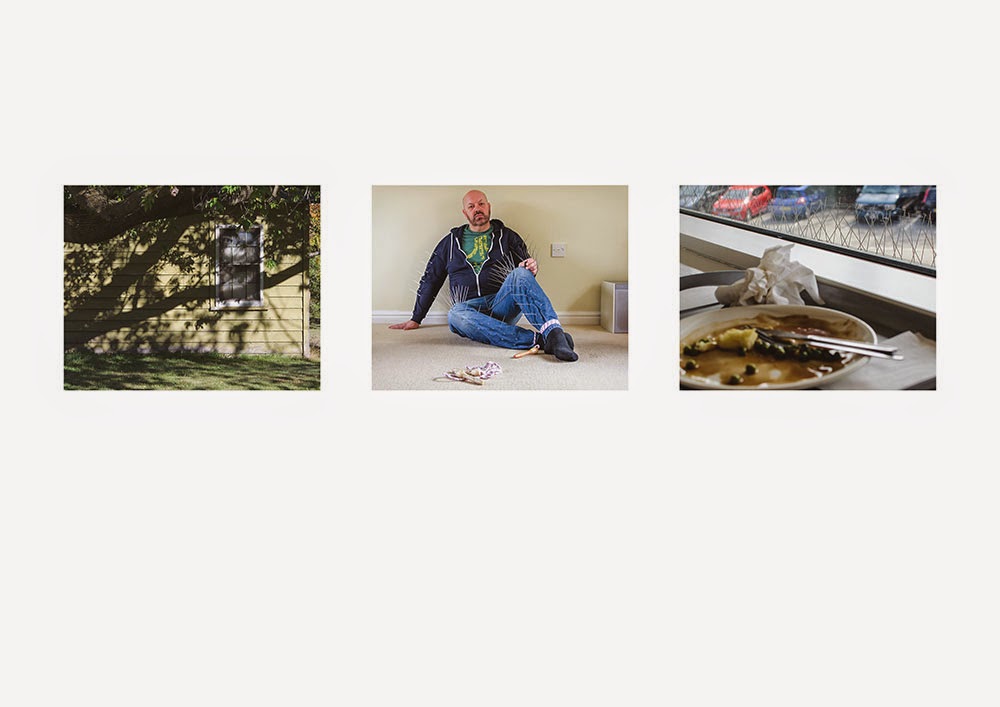
The first image in this sequence represents the family home. What happens here structures and informs the developing child's view of family and the the wider world. I'm always drawn to making images of house windows. For me they represent both safety and isolation.

The second image is my take on metaphorical body armour; how a protective cocoon of spikes can help and hinder ones personality at different times and in different contexts. The skipping rope is a metaphor for childhood beginnings, where play and learning take place, and childhood experiences are laid down that are carried into adulthood.


The third image shows anti-pigeon spikes on a ledge at a local cafe. An individuals world view is tempered by past experience. This image attempts to portray how, even in the most mundane situations, parallels with past experience can be recognised by an individual.

Fetish : 
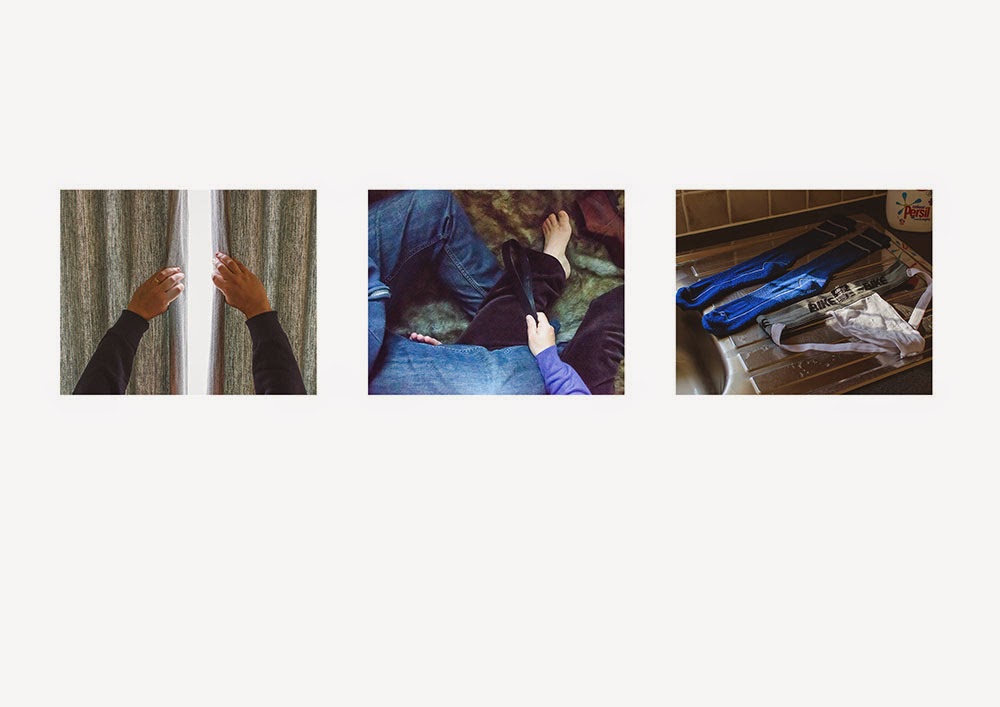
These three images show the private, varied and banal sides of fetish and human sexuality. In the past, sex was often lifted up to some lofty idyll in the arts, as if in an attempt to try and justify the subject in some way. Sex is sex. Animalistic and passionate. That aspect often seems to be missing from the subject in Art. Even Robert Mapplethorpe when he explored these subjects, used a Formalist approach that was, although controversial, primarily aesthetic.

In reading the introductory text to the book 'Robert Mapplethorpe' Keith Hartley states:

Taking his cue from Warhol, who used self-portraiture as a means of self-promotion, self-disguise, self-delusion and self-discovery, all at the same time, Mapplethorpe photographed himself again and again...] [ In a number of works he laid himself bare; in others, he suggested facets of his sexual and emotional make-up...] Hartley (2006).

I find the writer's comments on the use of portraits to project and protect, explore and discover pertinent to the topic of group identities. I would argue that it is the use of different masks/multiple identities that allows us to do this – to try them on, to see how well they fit.

Consumer:
The first image shows how aspects of consumer culture is still changing our society today. It wasn't that long ago that the possibility to drink coffee 'on-the-go' wasn't even an option in the UK. Now coffee express machines are available at most garages, along with drive-thru fast food outlets etc.

The second image shows the British obsession with barbecues – even though our summers aren't particularly reliable, we have bought into a manufactured 'outdoor lifestyle' where the garden is considered an extra 'room' which rather handily for retailers, requires filling with goods.


The third image is conceptual. I wanted to show that although we appear to have choices and options, they are rather limited and directed to a specific purpose – to consume.


I then had to select one image from each set and discuss further:


The final four

In keeping with the assignment brief I have selected one image from each group to discuss:

Family group  - plates

Armoured group - window

Fetish group – fur rug

Consumer group - coffee cups

The reason for choosing these four is that I was conscious that they would now be viewed as a single group in their own right. Aesthetically they hang together well. They have similar tones and colour combinations. Also they are all contextual images without a visible face – which is quite telling and leans more towards my particular interests in photography.


Individually, the plates image is one of my favourites out of all twelve. I very rarely enjoy looking at images of people. I can admire the technical ability or composition but I much prefer contextual portraiture where there are objects to look at or the person is absent all together. That is why this particular assignment has been quite difficult for me. The window image, is again, a choice for contextual reasons. It is a metaphorical image that, for me, relates to childhood memory - as a child I spent a lot of time indoors looking out of windows. The fur rug image was quite fun to make and is completely staged. The fur rug is from my bed and has been placed on the kitchen floor. I then had to get into position with my partner and try and hold my camera up and shoot with one hand. I like the slightly blurred and grainy nature of this image – the jumble of legs, hands, and objects inject a dynamic element to the scene.


Below follows a chronology of my time spent on this assignment.


Chronology

Mar 23rd:

While sitting upstairs by the window of Sainsbury's cafe I had some inspiration for one of my identity groups. I'd been thinking about another prop I've just had made for my assignment 1 re-edit. The prop for this is to do with body armour. As I was thinking about the use of metaphor in my images - to relate body armour to protection and survival, I noticed the anti-pigeon spikes on the cafe's window ledge. Perfect! I could get hold of some of these spikes and incorporate them into clothing for more body armour images for this assignment. Hopefully this will also show a sense of continuity between the two assignments. As soon as I got home I did some Google searches and it didn't take long to find the plastic anti-bird strips and order them.

Mar 25th:

These are the cat masks that I've made for use in one of my family images. I need some elastic to turn them into wearable masks. I can't wait wait to re-create this Diane Arbus inspired photograph. The lawn needs cutting first so that the garden doesn't look too shabby - it needs to dry out a bit too.


Mar 30th:

The anti-pigeon strips have arrived and I've been busy incorporating them into a pair of jeans and a top. I had a lot of fun trying to get into the adapted clothing. Once on, it was hard to walk and not damage the walls, myself, or the spikes!


April 2nd:
More test shots today. I found a suitable space against a blank wall in my living room for my body spike shot. The light was better today and the spikes showed up well against both the dark blue hoody and the blank wall - good news, no artificial lighting seems to be required now. Because of using a new spot I did some more test images at different focal lengths. I had to switch to my 18-20mm lens and use a 30mm focal length to put my body in to the frame. Thinking about it now I need to be more methodical as I adjusted my tripod to get the camera lower to the ground. With the new tripod position I could probably swap back to my 35mm fixed lens - my preferred option.


April 12th:

At last a sunny day and the lawn is dry enough to make my Arbus inspired image. In my version I want to mess around with gender identity and family groupings - not sure quite why yet, but once made I'm sure the reason will show itself. I set up the chairs and a table with props. I asked Gerry to get into position while I sorted out the exposure and checked all the settings - I'm sure I drive him completely mad with my antics.


We tried a number of poses and in the end I was quite happy with the results. Here is Arbus's version alongside my own.


'A family on their lawn, one Sunday in Westchester, NY 1968'


'A family on their lawn, one Sunday in South Ashford, Kent 2015.'


April 15th:

A trip to the woods today for another image in my 'Family' grouping. I'd already acquired some plates from a charity shop. They are the type to be seen in a home from my childhood memories - quite 'cutesy' and very traditional. They were easy enough to find and I made a small selection. My idea is to photograph them outdoors, in a wood or field, and to show them half buried.

I eventually found a suitable spot and took some time to randomly scatter the plates. At some point I flung them over my shoulder to try and achieve optimum randomness and one of the plates hit another and broke. This turned out to be one of those 'creative accidents' that helped to break up the symmetry of the round plates against the dark wooded background.


April 18th:

My groups of images are coming along nicely now. I have a number of them and I'm thinking about presentation. I've decided to put the groups of three's onto a single piece of A4 paper for my tutor. The assignment notes asks for one of each grouping to be selected and printed bigger so I will print one from each, full size, onto A4 as well. I've begun post-processing in order to have them ready for uploading to the online printer.

April 21st:

I've made some more images today - all three of the 'fetish' identity group. I wanted a sense of action and movement in these images. I think I've achieved that. I was quite loose with the use of my camera - handholding, not worrying too much about shutter speed. I put a fake-fur rug from one beds on the kitchen floor and enlisted Gerry again to help me make the image. It was really uncomfortable trying to hold my camera up with one hand - it's a D7000, quite heavy - and keep my legs twisted into position and fairly still at the same time. I think the chosen shot was worth it. Most of them came out blurred or pointing in the wrong place.

April 28th:

The assignment notes are written, the images are back from the online lab and the whole lot is now in the post to my tutor. I enjoyed this assignment but am glad to be moving on. I am still quite behind with reading and blogging and keeping my learning log up to date. So much to do!

May 14th:

My tutor feedback for this assignment was fairly positive and there are a number of points that he also made that I need to address before assessment. My tutor felt that the supplied images were too small. He felt frustrated that he couldn't fully see the detail. Catherine, a fellow OCA student, also made a similar comment (if I've read it right) when looking at the images online. I'm kind of pleased by the comments. My intention was to make them small and hard to read. I wanted to create a sense of needing to peer closer, to try and grasp at detail but not quite get there. If I'm entirely honest I don't think I want to be understood. Part of my armour for so long was/is to keep people at a distance. It is what I'm used to doing and where I'm comfortable. So in a way the difficulty of reading the small images could be seen as an intrinsic part of understanding my personality.

I have to find some way of incorporating this element into the assessment. I've toyed with the idea of using a small hand-held slide viewer and creating slides. I have this notion that by holding the slides up to the face the viewer will feel closer to the images, but at the same time the small size will still hold them back. I have to do some investigations into how I can transfer my digital file to slides. I may be able to get this done online, or I may just end up re-photographing the printed images with a 35mm slide camera. Lots to think about.

Jan 20th:

I'm revisiting this assignment in preparation for assessment. My tutor feedback for this assignment noted that I hadn't quite met the brief. This is because the original assignment was supposed to allow for feedback from the sitters of the group portraits. This was to allow them to pick an image that they liked and provide a difference in perspective. Obviously as my group portraits are identity groups of myself, this difference of opinion is lacking.

To counter this I took the images along to the January Thames Valley study group. I showed the images to the group and asked for a favourite image and the reasons why.


A number of the group liked an image from the 'fetish' group the most.


The comments made stated that the image was:

"erotically charged"
"alluring"
"enticing"
"anticipation of revelation"
"you couldn't have made a less sexual image that is so sexual"
"[the image has] a deep connection to the word"


The other image that received a number of favourable comments was from the 'family' group.


The comments made stated the image was:

"relaxed looking"
"in my space"
"positive"
"happy"

[also a contextual comparison was made to the Diane Arbus image 'A family on their lawn, one Sunday in Westchester, NY 1968']


Finally the only other two images mentioned by individual group members were this one from the "armoured" group:


It was mentioned that the spikes conveyed:

"pushing away" [of people]
"attack is a form of defence"
"self harm"


This image is from the "armoured" group:


The aesthetic qualities of this image were mentioned:

"dappled light"
"poetic"


I found this exercise to be very interesting. It was good to know that the majority reading of the fetish image was similar to my intent when making it. It was the image most talked about around the table and seems to have struck a resonant note, which is always good to know when making work.

I was also struck by the fact that some of the students seemed to gravitate to the more "positive" groupings, steering away from images they perceived as "negative".  Is this a form of defence mechanism that kicks in when looking at work that may be perceived as dark or troubled? It may be that students will not share thoughts about this work because of the awkwardness of the image maker sitting in such close proximity.  These are interesting issues to think about that add a depth or extra layer to the work when it is out of the hands of the maker.

Sunday, 15 March 2015

Alexander Gronsky

This photographer is primarily a maker of contemporary urban landscapes. The work is composed in a formal way with great attention given to how the compositions interact with the edge of the frame. Additionally the eye is drawn to the tiny figures in the compositions, dwarfed by trees, structures, vistas. Most of the work I've seen so far is taken in Eastern Europe and there is a cold clean light that pervades the landscapes.

Taken in the same environments, Gronsky's 'Pastoral' work looks at the familiar subject of edgelands - unused spaces that interconnect the rural and the developed. In Gronsky's images people inhabit these spaces, sunbathing, passing through, standing forlorn. They are surrounded by the detritus of urban living or large scale development - usually taking place in the distance. The people look like they are disconnected from the landscape somehow. As if they are unsure of how to inhabit the space or are lost and adrift.

Edgelands are often seen as a metaphor for contemporary urban culture and how we are now so disconnected from nature and the necessities for our own survival. The title of 'Pastoral' for this work seems incongruous as the term usually refers to a mythical ideal rural landscape of beauty and tranquillity that bears no resemblance to reality. I can only surmise that there is maybe some irony in choosing the title, because the scruffy nature of the edgelands are at odds with the pastoral idyll. I wonder if these are the only places available to escape and gather ones thoughts in these Eastern European urban environments?


Friday, 13 March 2015

David Hockney

The earlier work of David Hockney is very appealing to me. The Splash images depicting Californian swimming pools use a restricted colour palette. The content and style exude a calming almost indifferent attitude. Probably because the beautiful people living their beautiful existence seem almost like Gods to me. As a voyeur of those scenes, I feel I could easily be standing, face pressed against the railings, at the gates of an exclusive house to which I would not be given admittance.

I envy those cool blue swimming pools and uncluttered Modernist houses. The paintings are mood lifters. Visions of warmer days and fresh sunny Californian mornings - promises of uncomplicated sex and wet foot prints on cool tiled floors. I could live in those paintings.


If I'm honest, I think the images appeal mainly from a sensual perspective. The desire for my own swimming pool in a hot country and to be young again. Although having taken a break from writing this post I've had time to reflect on my thoughts. I've had an idea for a Hockney inspired piece of work or series that deals with the emotions of longing and exclusion. I enjoy the process of taking thoughts and emotions and turning them into possibilities for art. I keep a sketchbook just for this purpose. I think I will jot these ideas down in case I have a need to refer to them again at a later date.

I also enjoyed looking at Hockney's Polaroid montages - both the actual photographic works and the drawings inspired by them. I have a Polaroid camera, given to me as a present, and I've been tempted a couple of times to use it to make a piece like the one below - not necessarily a nude. I'm always held back by the cost per image. Maybe I should give it a try.


The image below uses a much stronger colour palette than the Splash paintings. There is an immediacy to the work because of this and of course the fact that the montage is made up of photographs and not painted. I've seen the original in a gallery and it is a very large piece if I remember rightly. Hockney used a step ladder to get some height for parts of the composition and used different perspectives to jumble up the spatial characteristics. The work is more interesting for that.


Thursday, 12 March 2015

Laurie Toby Edison

The work of this photographer is made in an attempt to bring about social change. Edison, initially a sculptor and jewellery maker, took up photography in order to fight for a cause. She wanted to show that larger women can be portrayed as beautiful. The book 'Women En Large: Images of Fat Nudes' took the form of a slideshow in its embryonic stage. The images were shown in various communities to generate discussion around the portrayal of large women in the media.

Similarly, Edison's next project also looked at the issues of body image. 'Familiar Men: A Book of Nudes' this time looks at masculinity. Whilst working on the subject Edison began to realise that masculinity was a complex and largely untouched subject matter. As she states in an online interview with Crescent Blues, the issues that affect and define men and women can be very different:

Crescent Blues: What kinds of issues are emerging as you do the work?

Laurie Edison: One thing I think is an excellent example of this: men are almost exclusively defined by what they do. When you show someone a book of female nudes, no one ever asks, "I wonder what she does?"

Crescent Blues: "Is she a lawyer; is she a doctor; is she a housewife?"

Laurie Edison: No one has ever asked that about any individual photograph in Women En Large. But when you take men's clothes off, people often literally become confused. Men are so defined by what they do; and what you do and how you fit into the whole structure of things is defined by what you wear. The absoluteness of it really floored us.

Full interview Crescentblues.com

This kind of photography is very much rooted in creating social change. It has a basis that strengthens and informs the images. I like the idea of working with communities to make pictures that comes out of, and reflects discussion, but I'm not sure it is a stance I could take myself. I'm not totally comfortable with large groups of people and I certainly wouldn't like to take a directive lead in projects such as Edisons.

I do think about similar issues around identity in my own work though. I just plug at it from a different perspective. I think there is plenty of room for many different approaches - the making of work that is constructed can still take a viewer along a narrative path and hopefully lead them to think about the subject of identity more deeply.

Thursday, 5 March 2015

David Favrod

David Favrod caught my attention a couple of years ago. He makes constructed photography, often relating to memory or stories he was told by family members. He often uses props in his artistic practice too. There is a quirky nature to the work. In 'Hikari' Favrod photographs himself wearing a jumpsuit and a pair of wings - he looks like some sort of mad inventor and the image draws me in. The sequence relates to childhood stories of WWII told to him by his Japanese grandparents. The image of the little girl with the watermelon crash helmet is an inspired interpretation of her personal, and sadly unfortunate, story. The sequence of wooded landscapes have a bleakness to them that is informed by the constructed photographs - an extra dimension is given to the work by the juxtaposition of the two kinds of images. Favrod also uses text, layered across some of the images, that creates sounds in the mind (at least for those that can read Japanese).

Most importantly, room is left for the viewer to find a sense of common ground. They can interpret the work in ways that fit with their own personal experiences of family strength through hardship that is universal. OCA tutor, Sharon Boothroyd has an interview with Favrod on her blog Photoparley.


SB. "How important is mystery to you? And why? Do you want the viewer to bring something to the work?" 


DF. "Mystery is very important in my work. Indeed it’s really important for me that the viewer brings his or her own history to the work. I don’t explain in the exhibition the stories behind each images there is only my statement in the entrance. So the viewer has the general idea but I hope they will ask themselves to create their own story with the different images." Favrod (2014).


Full interview on Photoparley


With my last two assignments I've also attempted to explore themes that are personal to me that leave space for the viewer. I'm still finding my way, attempting to get the balance right. I'm not sure I'm there yet. Assignment 2 'Rubber Flapper' seems to be my most successful so far - even though it's not finished. The sequence has a direct narrative to follow unlike assignment 1 which uses dual narrative and is more open ended - again thinking to be done on this assignment too.

Seeing the work of photographers like David Favrod reinforces the belief that the constructed image can be used in many ways to create strong images with complex narratives. The visual language of photography is an effective way to show what often cannot be seen, cannot be found, cannot be told.

Tuesday, 3 March 2015

Tracey Emin - Why I Never Became A Dancer, 1995


I watched this short film by Tracey Emin at the Turner Contemporary, Margate recently. I will write about the exhibition Self in more detail in a later post. The show pulled together a number of artists in order to comment on the self portrait:

'In a world where 'selfies' have become everyday expressions and ‘Britishness’ is being redefined, what is the role of self-portraiture and how has it shifted through the history of art to the present day?' Turner Contemporary (2015).

I wanted to comment on this particular piece of work because of the deep affect it had on me at the time. Before I'd even seen the film I could hear Emin's voice, if not her words, from a concealed video booth in a corner of the gallery. I'd wandered around the exhibition, looking at various pieces, and every six minutes or so Emin would stop and the silence would be filled with the exuberance of a 1970s Disco track. 'You Make Me Feel, (Mighty Real) by the performer Sylvester, is one of my favourite songs. In the pristine whiteness of the Turner Contemporary, the pounding disco beat and the soaring synthesiser rhythms felt even more potent. I almost wanted the lights to dim and see mirror balls descend from the ceiling - Emin's video piece commanded the room.

By the time I entered the booth and sat down to watch the short film I already had the track firmly embedded in my head. The film appeared to be a scratchy old Super 8 visual of Margate, recorded during a long gone summer. The camera panned up and down the seafront, showing the beach, the clock tower, the arcades and promenade. The narrative that I'd only heard in faint snatches earlier described how, as a teenager, Emin had indulged in under age sex with older guys - and what a life experience that had been for her. How, as she matured, but still being young, realised that she had outgrown Margate and looking for a way out had entered a national disco dance contest. The very same men that she'd had sexual encounters with earlier in her life stood at the edge of the crowd and chanted "slag" over and over during her performance - ruining her chances of winning and escaping Margate. Emin fled the event in tears and the experience made her realise that she was better than all of them. She was definitely leaving now and nothing was going to stop her.

In the last section of the film Emin calls out the men's names and shames them, declaring "This ones for you!" The music begins, the disco beat and Sylvester's voice sucking me in. The visual changes to what looks like an open space in a gallery or high end apartment, with a glass wall overlooking a London skyline. Emin dances around the empty space, recreating the moves she never got to finish in a pair of cut down jeans - enjoying the moment, knowing that she had overcome, she had escaped, and those guys, probably still back in Margate in dead end jobs were nothing to her.

Is this a piece of revenge art? It could considered so. It is also often life affirming and cathartic for an artist to create such a piece and slay past demons. I know how that feels. It is also a piece of self portraiture that uses historical context that provides insight into Emin's character. A book I've read recently about the psychology of human group mentality made me also look at this piece of work from another perspective. Looking at identity I find it interesting how Emin's description of the failed disco dancer at the hands of misogynistic men, fits so well with the concept of group mentalities. Emin may have wanted to adopt the identity of 'Disco Dancer' but she also needed the approval of this identity from other groups for it to stick. The 'Patriarchal Male' Group weren't prepared to accept this, preferring to cast her in the role of 'Slag' instead.

The book is true on this point. The individual does not have full control over their identity - it is something to be negotiated by the individual and everyone around them. We can try on identities to see how they fit but we don't necessarily get to keep them. The 'Disco Dancer' identity was not a success for Emin. Fortunately with the passage of time and growth in confidence - along with artistic success - Emin is able to re-assert a new identity. This time Emin is a member of the group 'Successful Artist'. I wonder what identities those men now inhabit?

This piece of work, like most of Emin's other pieces, are founded in her own life experience. Emin uses memory and emotion to investigate and make art. This artistic practice has been used by many other artists too. Photographers Nan Goldin, Larry Sultan and Richard Billingham have all plumbed the depths of personal experience to make their art. As a student I'm finding my own way down this particular path. Sometimes a piece of work that I make may seem fairly obscure or light-hearted. But there is also an essence of me in there somewhere. Maybe not as heart on sleeve as Emin's 'Why I Never Became A Dancer'. But there  is always a sub narrative in my work that speaks of the personal experience of childhood loneliness, parental indifference, rejection and growing up as an outsider. It would be tiresome to approach and re-work the same subjects over and over. So I change the viewpoint. Look from a different perspective. Delve into fantasy - but the themes are there all the same.    


Monday, 2 March 2015

Questioning Identity: gender, class, nation - Kath Woodward

This book is on the reading list for Gesture and Meaning. It's written as part of an introduction to the Social Sciences and attempts to explain the psychology of group mentality in humans.

In order to understand who we are as an individual we must be able to see sameness and difference in others - to know who we are we must also know who we are not. In that way we create our own identity, by accepting or rejecting aspects of one another. This is where group mentalities come into play. We mentally join groups where we see perceive sameness. We are all members of many different groups: Adult Child, Married, Single, Parent, Teacher, Engineer, Unemployed, Religious, Atheist, Guitar Player, Bird Watcher, Creative. We can move between many different groups, adopting different identities for each one. We don't necessarily behave the same way with our parents or at work as when we are with our friends. The more successful we are at maintaining an identity the more we will be accepted within a group.

Within these groups we negotiate a hierarchy. The individual that is the most knowledgeable Engineer in the group, who best fits that identity, will be accepted as such by the other members of the group. The other members jostle for position around that perceived 'ideal' identity and fit in accordingly. The group can be accepting of more quirky interpretations of the Engineer identity and evolve or outright reject difference and remain static.

An individual may perceive themselves as a member of the School Parent group and attempt to join. They will be scrutinised by the other members of the group and assessed for the qualities of the identity required. If it turns out the correct qualities are perceived as lacking, the individual may be relegated to the bottom of the group or cast as Other - not necessarily accepted. The individual cannot maintain an identity alone. They need recognition from the other members of the group for that identity to be successful.

Groups themselves negotiate within a hierarchy of other groups. Groups that we do not belong to we perceive as Other. The Engineers group may perceive itself as superior to the Admin group in an organisation. This can only happen if the Admin group accepts the place given to it by the other group. If there is disagreement then there is a power struggle and conflict arises.

External factors can play a part in determining identity. Gender, Race, and Class have a big influence in most societies. Groups operate within social structures created by Political groups for instance. These groups can determine the success or disadvantage of members of the other groups. Women, Working Class, Minority and Ethnic Groups, not only define their own identities but have to negotiate a world that is controlled by influential groups that also have a major input. In order to play a role (adopt an identity) we must be seen by others. Other groups can accept or reject aspects of that identity and make decisions on its behalf. For instance the ability of women to be be able to fight in the military is a perceived quality that other groups will have influence over.

This book has been very informative and has helped me to see more clearly how identity is formed and how an individual moves effortlessly between many different identities in different contexts. Also that we are not able to inhabit an identity without the consent of others. How we are seen and perceived by others is very influential in the success of any adopted identity. Membership of groups helps to re-enforce a chosen identity.